
CLEAR LEADERSHIP
Better Operations.Stronger Leaders.A Business That Runs Better.
CLEAR Leadership helps manufacturing, distribution, and growing businesses identify operational constraints, improve performance, and develop stronger leadership teams. We bring real-world executive operating experience, practical answers, and measurable progress.
BUILT FROM THE FLOOR UP
I don't diagnose operations from a conference room.
I've spent more than 20 years inside real operations, leading teams, fixing bottlenecks, increasing capacity, improving margins, and turning operational problems into measurable results. CLEAR was built from that experience, not from a consulting playbook.
Real operations. Real people. Measurable results.
THE PHILOSOPHY
CLEAR isn't a box to check. It's a way of life.
Leadership is how you show up when production is behind, a customer is upset, someone makes a mistake, or your team tells you something you don't want to hear.
Create Safe Spaces
People need to know they can speak honestly without paying a price for it.
Lead by Example
The standards you demonstrate will always matter more than the standards you post.
Encourage Open Communication
The people closest to the work often know where the problems are first.
Actively Listen
Don't listen to respond. Listen to understand what's actually happening.
Remember to Be Present
Leadership happens in the moment, with the people doing the work.
WHERE IT STARTED
Before CLEAR had a name, there was a pen factory.
Some of my earliest lessons about leadership came from my family’s pen business, and from the people who taught me what it meant to support the people doing the work.
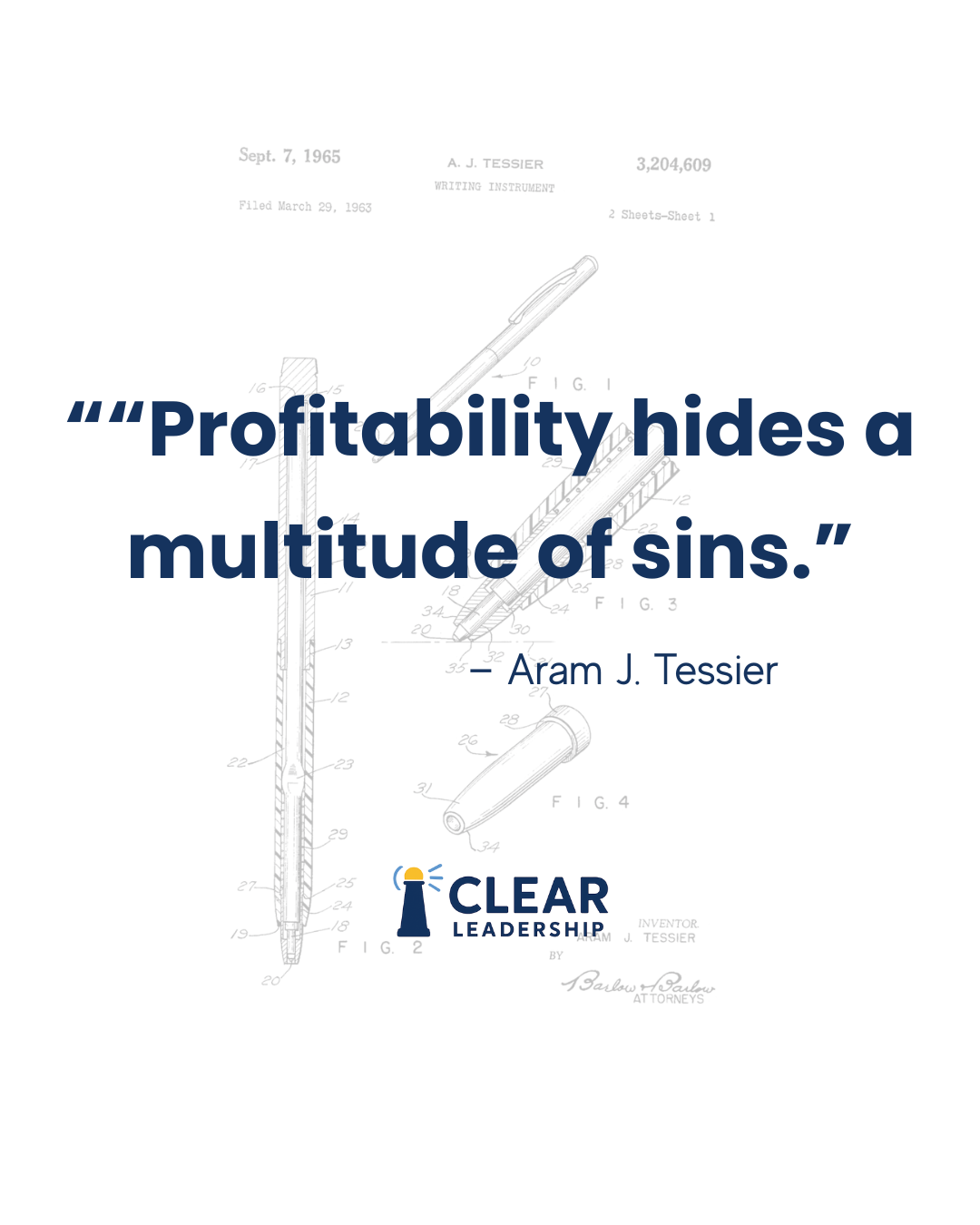
My grandfather, Aram J. Tessier, and my uncles, Ray and Philip Tessier, owners of Quill Pen Company, shaped the way I learned to see operations. Leadership was not about sitting above the work. It was about staying close enough to understand it, removing friction, and giving people what they needed to succeed.
One of my grandfather’s lessons has stayed with me throughout my career:
“Profitability hides a multitude of sins.”
Good numbers can make broken processes easier to tolerate. Waiting, workarounds, wasted capacity, unclear ownership, and unnecessary friction can stay hidden while the business is making money. CLEAR grew from learning to look underneath the result and understand what is really happening.
CLEAR is the framework I use today. The roots go back generations.
PROVEN BEFORE IT HAD A NAME
CLEAR existed before it had a name.
I didn't create CLEAR and then decide to lead this way. The framework came from recognizing the principles that had shaped how I led for years, on the floor, through growth, under pressure, and alongside the people doing the work.
“Working together we were able to find creative solutions to everyday problems that would help both boost morale and increase productivity.”
Matthew Gianturco
Former colleague
“He is always looking for ways to streamline and advance the business while still keeping an eye on employee morale and productivity.”
Jessica Moloughney
Former direct report
“Aram's attitude was ‘Let's get it done.’ ... We were able to meet and exceed our sales goals and double the size of the company in three years.”
Ray Rodriguez
Former VP of Sales & Marketing
“You are a compassionate leader, a leader who sees the best in people and their potential. Brace yourself to be challenged, and to grow.”
Osbert M.
Former team member
The principles behind CLEAR have guided how I lead for years.
SEE THE REAL OPERATION
The numbers usually aren't the first place I look.
A spreadsheet shows you what happened. It doesn't always tell you why.
That's why CLEAR starts where the work actually happens, on the floor, with the people, inside the process.
That's where you find the workarounds, waiting, bottlenecks, unclear ownership, unnecessary steps, capacity problems, and things everyone has simply learned to live with.
THE CLEAR PERFORMANCE DIAGNOSTIC
What's actually holding your business back?
Where is your business losing profit, capacity, cash and execution performance, what's causing it, and what should management address first?
01
See the work
Start with operating reality, not assumptions.
02
Find the constraint
Identify where flow, capacity, decisions or information get stuck.
03
Measure the impact
Connect operational friction to capacity, cash, profit and execution.
04
Decide what matters first
Turn findings into clear management priorities.
WORK WITH CLEAR
Defined engagements. Practical answers. Measurable progress.
Choose the level of operational support that fits the problem. Not every engagement requires a separate assessment.
01 / ASSESS
CLEAR Operational Performance Assessment
Starting at $7,500
Know what's holding your business back before spending more to fix it.
A focused review of constraints, workflow inefficiencies, capacity and profitability opportunities.
- Executive discovery and confirmed scope
- Current-state workflow map and KPI baseline
- Root-cause and constraint analysis
- Estimated economic impact, where supported by data
- Up to three prioritized findings, where identified
- 90-day roadmap, executive report and presentation
Typically 10 business days after required access and information are provided. Starting scope covers one defined facility or workflow.
Schedule an Assessment Conversation02 / LEAD
CLEAR Executive Advisory & Fractional COO
Advisory $6,000/month
Fractional COO $12,000/month
Experienced leadership without immediately hiring another full-time executive.
Advisory supports executive decisions, KPI reviews and accountability. Fractional COO adds deeper operational involvement and oversight of agreed initiatives.
- Operating KPI scorecard
- Executive action and accountability register
- Scheduled leadership meetings and coaching
- Operational priorities and monthly progress report
Advisory includes up to two professional service days monthly. Fractional COO includes up to four. Three-month initial commitment. A professional service day is up to eight hours of combined meetings, preparation, analysis, reporting and other contracted delivery. Unused monthly capacity does not roll over. On-site visits are scheduled in advance. No unlimited or emergency coverage.
Discuss Executive Support03 / IMPROVE
CLEAR Operational Improvement Projects
Starting at $20,000
Stop managing the same operational problems. Start correcting their causes.
Defined improvement work focused on specific constraints, avoidable costs, workflow problems and accountability gaps.
- Written project charter and performance baseline
- Root-cause analysis and agreed solution
- Milestones, owners and progress updates
- Documented operational controls and management handoff
- Final results and recommendations report
Typically 60 to 90 days. Fixed scope and defined deliverables. Qualified CLEAR operators may deliver projects using consistent methodology and founder quality review. Scope, staffing and complexity determine final fees.
Discuss an Improvement ProjectCompare the engagements
| What you receive | Assessment | Advisory / COO | Project |
|---|---|---|---|
| Defined scope and baseline | Included | Agreed KPIs | Included |
| Constraints and priorities | Findings report | Ongoing review | Root-cause plan |
| Action and accountability | 90-day roadmap | Monthly register | Milestones and owners |
| Executive reporting | Final presentation | Monthly report | Progress and final report |
| Implementation | Not included | Oversight within scope | Agreed changes |
All engagements require a written scope defining deliverables, responsibilities, milestones, limitations and acceptance criteria. Additional executive consulting is $2,000 per professional service day, subject to scheduling and written approval. On-site visits require advance scheduling. Approved out-of-area travel costs and significant travel time are addressed separately. Fees exclude outside software, third-party expenses and additional work beyond the contracted scope. Financial outcomes are not guaranteed.
HOW CLEAR WORKS
From the real problem to accountable progress.
We tailor the stages to the engagement. Not every client needs a separate paid assessment.
- Discovery and qualification
- Define the problem and scope
- Assess or establish the performance baseline
- Identify and prioritize corrective actions
- Implement or support agreed improvements
- Measure results and transfer accountability
HISTORICAL EXECUTIVE EXPERIENCE / TEKWELD SOLUTIONS
The 20-Foot Wall of Waste
At Tekweld Solutions, Aram identified recurring duplicate production that had led to an approximately 20-foot accumulation of finished products. He developed an upstream order-validation formula that eliminated the duplicate-production problem.
The lesson: Recovering capacity doesn't always require more employees or equipment. Sometimes the right correction is upstream.
This example reflects Aram's prior executive operating experience, not a CLEAR client engagement.
BEYOND THE ENGAGEMENT
Leadership Development & CLEAR Forward
Developing people is part of CLEAR's mission. Corporate leadership development and individual mentorship are separate from the operational services above. Defined programs, scope and pricing will be announced when validated.
FROM THE FACTORY FLOOR
Capacity improved, and the people grew with it.
Operational improvement has to work after the consultant leaves. At Peerless, the work included factory automation, process improvements, production guidance, SOP creation templates, clearer responsibility, and coaching the people responsible for carrying the work forward.
“I am confident our capacity has risen by many of the changes you implemented... And to get the buy in from the people out there.”
Dan · Peerless
CapacityAutomation and process changes designed around how the factory actually worked.
AdoptionFloor buy in, practical production guidance, and follow up with staff.
LeadershipResponsibility and development for emerging leaders so improvements had internal ownership.
CLEAR ANSWERS
Questions growing businesses ask when operations stop feeling simple.
Short, practical answers about operational leadership, bottlenecks, capacity, owner dependency, and knowing when outside help actually makes sense.
When does a company need a COO?
Look beyond company size. The better signal is whether operating complexity has outgrown the current leadership structure.
COO, fractional COO, or operations consultant?
Start with the problem you need solved, then decide how much ownership and ongoing leadership it requires.
Why does everything in my business have to go through me?
When normal work waits for one person, the issue may be decision flow, ownership, standards, or structure.
When does a gatekeeper become too expensive?
The salary may not be the biggest cost. Measure the work, decisions, and people waiting behind the gate.
How do I find the bottleneck in my business?
Trace where work waits, returns, piles up, or repeatedly needs escalation before trying to fix everything.
Should I hire more people or fix the process first?
More payroll fixes a true capacity shortage. It can make a broken process more expensive.
WHAT IT'S LIKE TO WORK WITH ME
“Aram combines insight and empathy with real-world experience, and he brings out the best in the people around him. He pushed me to think differently, challenged me when I needed it, and gave me the confidence to take steps forward.”
Pablo · Former colleague and leadership mentee
“Aram was always on top of his game and solution driven. He treated his colleagues with respect, followed through on challenges, and made sure solutions were completed. Aram displays real integrity.”
Rich · Former colleague
“Your life and industry experience, personal philosophy and contacts are a rare combination ... collaborative leadership, empathy, mindfulness, roll up the sleeves and get it done. The business case ROI is not lost on me.”
Briana · Client perspective
OPERATOR FIRST
I've spent my career where leadership meets the floor.
I'm Aram Tessier, an operations executive, business owner and founder of CLEAR Leadership.
I've led organizations through growth, operational change, capacity constraints, margin pressure, and the everyday reality of getting people, process and technology to work together.
Today, I'm still an operator. CLEAR isn't based on what I think operations should look like from the outside. It's based on years of being responsible for the result.
NOT SURE WHERE TO START?
Let's talk about what's getting in the way.
You don't need to have the problem figured out before reaching out. Tell me what you're seeing, what's frustrating your team, or where performance isn't matching expectations.
Start a Conversation